
How to Write an Assignment Conclusion
Students eventually reach the finish line when working on writing an assignment. Their research is thorough, and their arguments are well-written. All that is left is to finish the task, but how do you write an assignment conclusion? Many students make the mistake of neglecting the final section, and that is incorrect. In fact, an assignment conclusion is one’s last opportunity to persuade the reader in one’s position.
A strong conclusion concludes on a positive note, while a careless one leaves a negative impression on the marker. Everything students need to know about finishing an assignment is included in this tutorial, including how to strat a conclusion, what errors to avoid, an example of a conclusion, and how to get professional assignment assistance if necessary. If one learns how to do it correctly, writing a concluding paragraph for an assignment is simple.
Why the Assignment Conclusion Is Important
An assignment conclusion is the final argumentative section of the paper since it is where students tell the marker why one’s efforts were worth attention. Most importantly, assignment conclusions leave the strongest impression on the marker, as they normally remember the beginning and the end of the work.
How to Write an Assignment Conclusion
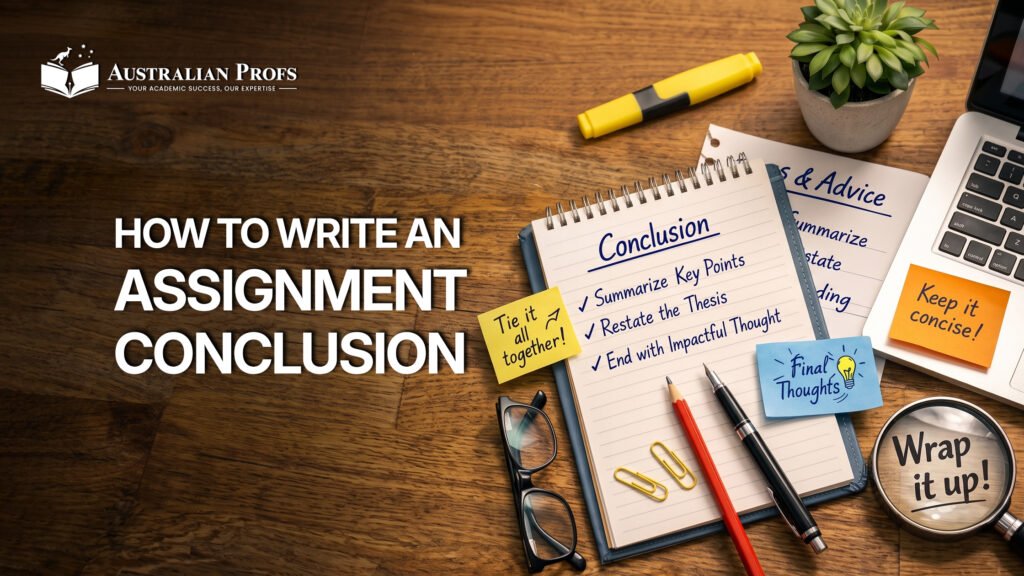
The assignment’s concluding paragraph has a standard format that can be mastered easily. First of all, students should restate their thesis statement using different wording to show the marker that one understands how to develop one’s ideas further and to create a smooth transition from the main body to the assignment conclusion.
Next, one should summarize their arguments in a couple of sentences, briefly mentioning all the points covered in one’s work without going into detail. After that, explain why one’s findings are important and elaborate on their significance to support the initial thesis statement and to demonstrate one’s expertise and involvement in the chosen topic.
Finally, it is time to come up with a strong closing sentence or two to end the assignment on a good note.
Start an Assignment Conclusion
Students often ask how to begin a conclusion for an assignment. I recommend not starting with a phrase such as “, in conclusion” because it simply does not sound impressive. Instead begin the assignment conclusion by restating the thesis or use a hook that leads directly to the section of the research findings.
End an Assignment Conclusion
Students also ask for help with how to end an assignment. If one wants to know how to finish an assignment strongly, one should bear in mind that the assignment conclusion should always be strong too. To create a powerful ending, one should follow the previously mentioned steps to come up with a strong closing sentence.
Assignment Conclusion Example
One may find it easier to finalize an assignment if they look at a well-written assignment conclusion example. Take a look at the following assignment conclusion example:
“The results of this assignment, which emphasises how social media can influence consumer behaviour, can be crucial in assisting businesses in comprehending the potential benefits of social media platforms. Because technology is ever-evolving, it is crucial to consider how digital tools can change human interactions. To boost brand loyalty, companies should especially concentrate on developing deep connections with consumers. Additional research should be conducted to learn how social media platforms can shape consumer behavior beyond the current findings.”
As one can see from this assignment conclusion example, the writer began with a restatement of their thesis and summarized their research. The concluding paragraph of this assignment ended with a strong closing statement that went beyond the initial claims.
What Are the Common Mistakes When a Conclusion Is Written?
Although most students know how to conclude an assignment, some mistakes occur quite often among students. One of the most common errors is to introduce new arguments and evidence in one’s assignment conclusion.
That is wrong because the concluding paragraph serves to summarize the paper, not expand upon it. Another mistake is to copy the assignment introduction and conclusion, which makes little sense. At this point someone needs to show that they have learned how to write kinds of paragraphs which is why repeating the same thing is not allowed. Another mistake is to use words when finishing a task as it makes the work less good.
Finally, some students make the mistake of ending abruptly at the end of an university assignment. In reality, one should always finish with a strong closing statement. By avoiding these common pitfalls, students will be able to write a great assignment conclusion.
Assignment Conclusion Tips for Different Subjects
Some students ask for help with assignment conclusion tips for different subjects. Unfortunately, there is no universal approach to finalizing different assignments. For instance, nursing assignments normally require students to focus on the impact an assignment has on the patient.
Students who are unsure how to handle assignment conclusions or assignment help can ask for general assignment help or seek nursing assignment help from experts. Business assignments, on the other hand, require an emphasis on recommendations, whereas science assignments normally conclude with research suggestions to further explore the topic.
How to Write a Conclusion Paragraph in Relation to the Whole Assignment
The assignment conclusion should always be coherent with the whole paper and should smoothly transition from the introduction, and not only summarize what one has written.
If one uses a clear assignment outline, everything falls into place for the assignment conclusion as well. Understanding how to write an assignment in general helps finalize a paper quickly and easily. In other words, when students understand how to write the whole assignment, the task becomes less time-consuming and less stressful.
Additional Assignment Conclusion Tips and Tricks
When trying to figure out how to write a conclusion for an assignment, students should always read what they have written out loud to ensure that their assignment conclusion does not have unnecessary words that could be eliminated.
In particular, one should keep sentences short and to the point when concluding an assignment. Furthermore, one should try to keep the same tone and language throughout the whole assignment to ensure coherence and impress the marker with one’s ability to write a paper that has a good flow from start to finish.
FAQs
How to write a conclusion for an assignment?
One should summarise the main ideas of their work, paraphrase the thesis statement, and offer a compelling final sentence or paragraph in order to learn how to write a conclusion for an assignment.
What is an example of a good conclusion?
A good example of how to write a conclusion for an assignment can be seen from the rewritten thesis statement, a summary of the paper’s key arguments, and a strong closing statement at the end.
How do I end a conclusion?
One can end a conclusion with a closing statement that offers recommendations or suggestions for further research on the topic.
How do you structure a conclusion?
An assignment conclusion should be organised with a reiteration of the thesis, a synopsis of the main ideas, an explanation of the importance of the results, and a compelling final phrase or paragraph.
Get in Touch
Let Our Experts Prepare Your Assignment Help in Australia
Get expert assignment help Australia tailored to the requirements of top Australian universities. Our experts provide round-the-clock assistance to students who need to produce high-quality and original work. Whether you request someone to do my assignment Australia or need help with the entire assignment process, we’re here to help.